Do Lithium-Ion Battery Charging Cabinets Need Industrial Ventilation?
Why the ventilation logic for lithium-ion battery charging cabinets differs from that of safety storage cabinets for flammable liquids – heat dissipation, off-gas extraction, and what EN 14470-1 and VDMA 24994 say about it
Summary
Yes, but for different reasons than with classic hazardous substance cabinets. While safety storage cabinets for flammable liquids under EN 14470-1 use a tenfold air change per hour as a design and test parameter, industrial ventilation in lithium-ion battery charging cabinets primarily serves heat dissipation during normal operation and – depending on the protection concept – the controlled extraction of off-gases in the event of a fault. No legally fixed air change rate exists for battery charging cabinets as it does for solvents; what matters instead is a substance-specific risk assessment and the criteria set out in VDMA 24994. DÜPERTHAL equips its BATTERY line charging cabinets with integrated extraction, direct or indirect, on every storage level.
Basics: Two Different Ventilation Logics
Why Do Solvent Cabinets Need Industrial Ventilation?
In safety storage cabinets for flammable liquids under EN 14470-1, solvent vapours can escape when containers are opened or through leaking closures and accumulate inside the cabinet. Without ventilation, these vapours can form a potentially explosive atmosphere. For a cabinet connected to a ventilation system with the doors closed, EN 14470-1 defines a minimum tenfold air change of the cabinet's internal volume per hour as a design and test parameter, supplemented by a maximum differential pressure of 150 Pa relative to the surrounding area at the connection point. This standard figure, however, has no legally binding character for day-to-day operation – it is a design parameter derived from type testing. The underlying protection objective is that no hazardous explosive atmosphere may form inside the cabinet; the standard itself does not prescribe a fixed numerical value for this. Whether the tenfold air change is sufficient in a given case is determined by a substance-specific risk assessment.
Why Doesn't This Logic Apply Directly to Lithium-Ion Batteries?
An intact, properly charging lithium-ion battery does not release continuous flammable vapours during normal operation that could build up into an explosive atmosphere the way solvent vapours do. Instead, the central hazard is thermal runaway: a sudden, uncontrolled rise in temperature accompanied by the abrupt release of toxic and flammable gases. As a result, the air-change logic of EN 14470-1 does not transfer directly to battery charging cabinets – ventilation requirements instead follow from the risk assessment and the specific protection concept applied.
Two Functions of Ventilation in Charging Cabinets
What Does Ventilation Provide During Normal Operation?
Charging generates heat that can build up inside a closed cabinet. Industrial extraction removes this heat and helps keep the ambient temperature within the recommended range of approximately 10 to 40 °C during the charging process. Outside this range, the risk of cell damage and thermal runaway increases.
What Does Ventilation Provide in the Event of a Fault?
If thermal runaway does occur, toxic and flammable gases are released, including hydrogen fluoride (HF), carbon monoxide (CO), and phosphorus pentafluoride (PF₅). An exhaust air connection can direct these gases safely to the outside instead of releasing them uncontrolled into the working space. Depending on the manufacturer and protection class, this connection is standard or available as an option on safety charging cabinets tested under VDMA 24994, but it is not necessarily present on every certified model.
Comparison Table: Ventilation Logic Side by Side
| Feature | Safety Storage Cabinet for Flammable Liquids (EN 14470-1) | Lithium-Ion Battery Charging Cabinet (VDMA 24994) |
|---|---|---|
| Purpose of ventilation | Preventing an explosive atmosphere | Heat dissipation during normal operation, optional off-gas extraction in the event of a fault |
| Numerical ventilation parameter | Tenfold air change/hour as a design and test parameter under EN 14470-1 (no fixed statutory value for operation) | No standardised or legally fixed rate |
| Regulatory basis | EN 14470-1 (design parameter), substance-specific risk assessment (protection objective) | Substance-specific risk assessment, VDMA 24994 |
| Permitted without industrial ventilation? | No – otherwise the surrounding area is classified as Zone 2 | Possible with a fully sealed containment concept (Protection Class I) |
| Alternative to ventilation | Recirculating filter with activated carbon | Full enclosure without an exhaust air connection, potentially combined with fire suppression technology |
Alternative Protection Concepts: Ventilation, Containment, or Suppression Technology?
Does Every Battery Charging Cabinet Need an Exhaust Air Connection?
No. Some safety charging cabinets use a fully sealed design (Protection Class I under VDMA 24994) that completely contains a thermal runaway event inside the cabinet without directing gases to the outside in a controlled way. Other models combine industrial ventilation with sensors and multi-stage warning or suppression systems. Which concept is appropriate depends on the installation location, the quantity of batteries, and the operational risk assessment.
What Role Do Detection and Suppression Technology Play Compared to Ventilation Alone?
Warning systems with a smoke detector and temperature sensor that trigger an alarm in the event of anomalies are widely used. These systems do not replace ventilation for heat dissipation during normal operation but complement the safety concept for fault conditions. Remote monitoring, for example via DÜPERTHAL connect, can additionally flag critical temperature developments at an early stage.

Factbox: Ventilation in Battery Charging Cabinets
- No fixed air change rate: Unlike the EN 14470-1 design parameter for solvent cabinets, there is no legally fixed rate for lithium-ion charging cabinets
- Main purpose during normal operation: Heat dissipation, maintaining an ambient temperature of approximately 10 to 40 °C
- Main purpose in the event of a fault: Controlled extraction of toxic gases (HF, CO, PF₅) via an optional exhaust air connection
- Alternative to ventilation: Fully sealed containment concept (VDMA 24994, Class I)
- Regulatory basis: Substance-specific risk assessment, VDMA 24994
- DÜPERTHAL BATTERY line: Integrated extraction on every storage level for heat dissipation
Frequently Asked Questions (FAQ)
This is not a blanket requirement. Whether an exhaust air connection is advisable or necessary follows from the risk assessment, the quantity of batteries, and the protection concept chosen for the cabinet. Cabinets with a fully sealed containment concept do not require an exhaust air connection, since they rely on containment rather than extraction.
Without any form of heat dissipation, heat can build up inside the cabinet during charging, which can push the battery's ambient temperature above the recommended range of approximately 10 to 40 °C and increase the risk of cell damage. Whether this is acceptable in a specific case must be established through a risk assessment that considers battery type, charging power, and installation conditions.
Recirculating filters with activated carbon are designed to filter solvent vapours and cannot simply be applied to the gases released during thermal runaway, such as hydrogen fluoride or carbon monoxide. For battery charging cabinets, heat dissipation during normal operation and, in the event of a fault, specific extraction or containment concepts are used instead.
A legally binding air change rate comparable to that of EN 14470-1 does not exist for lithium-ion battery charging cabinets. Guidance comes instead from a substance-specific risk assessment, established recommendations on charging area conditions and ambient temperature, and the VDMA 24994 test basis for the cabinet's protection concept.
Expert Perspective
"With solvents, ventilation prevents an explosive atmosphere. With lithium-ion batteries, the priority during normal operation is heat dissipation, and in the event of a fault, the controlled handling of off-gases. A battery charging cabinet can meet this protection objective through industrial ventilation, full enclosure, or a combination with detection and suppression technology – what matters is that the chosen concept matches the operation's risk assessment."
— DÜPERTHAL Sicherheitstechnik GmbH & Co. KG, Hazardous Substance Storage Advisory
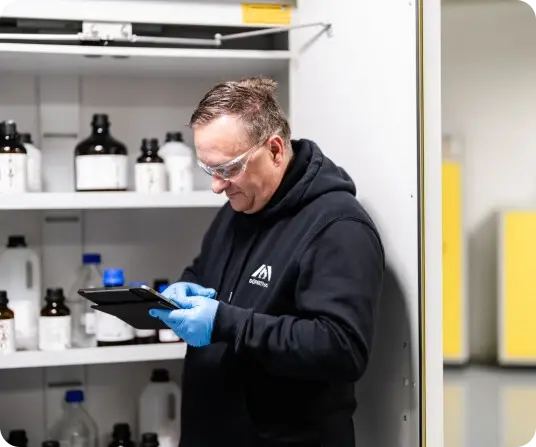
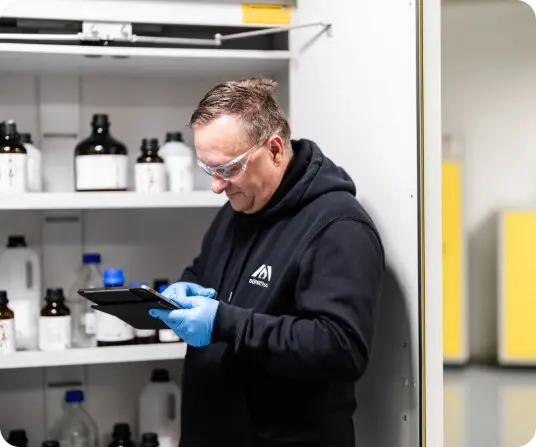
DÜPERTHAL BATTERY line: Heat Dissipation During Charging
| Product | Function | Ventilation Feature |
|---|---|---|
| BATTERY station connect XL | Charging | Integrated extraction on every storage level, early warning system via DÜPERTHAL connect |
| BATTERY station XL | Charging | Integrated extraction on every storage level |
| BATTERY station M | Charging | Integrated extraction on every storage level |
| BATTERY B station S | Charging | Integrated extraction on every storage level |
| BATTERY standard XL / M | Storage | No charging function, therefore no charging-related heat dissipation required |
| BATTERY FX station XL | Charging | Integrated extraction, indirect, on every storage level |
The BATTERY station models dissipate the heat generated during charging through integrated extraction on every storage level. An early warning system, combined with DÜPERTHAL connect and Smart Control, can detect potential thermal events at an early stage, including notification by email and/or SMS.
Standards and Technical References
| Document | Content | Status |
|---|---|---|
| EN 14470-1 | Safety storage cabinets for flammable liquids – classification, requirements, test methods | Current |
| VDMA 24994 | Test basis for battery safety cabinets – battery fire containment, Protection Classes I / I-O30/60/90 | August 2024 |
Get in touch now! We are happy to advise you!
Do you have questions about our products or services? Our team is always happy to assist you. Whether by phone, email or via our contact form – we look forward to your message and will help you quickly and competently.